

You have done the hard work. You transformed your content into the formats modern audiences expect. You distributed it intelligently across the platforms where they spend their time. And it worked. Audiences arrived. From social feeds, from YouTube, from Threads, from wherever your distributed content found them. They landed on your site or encounter your content in some environment you partly control.
And then, for most publishers, nothing special happens.
They see the same page as everyone else. The same layout, the same content recommendations, the same ad load. It does not matter whether they are a loyal subscriber who has been reading you for a decade or a first-time social fly-by who stumbled onto your content from a TikTok clip. The experience is identical. That is not an engagement strategy. It is the absence of one.
The One-Size-Fits-All Problem
For most of the digital publishing era, publishers delivered the same site experience to every visitor regardless of their intent, their interests, or their relationship to the brand. That approach made sense when traffic was relatively homogeneous, and most visitors arrived through search, with broadly similar intent, looking for content they had actively sought out.
That is no longer the traffic profile most publishers are managing. Today's visitor mix is far more varied. On any given day, a publisher's audience might include loyal subscribers, lapsed readers re-engaged through a newsletter, casual social visitors who clicked a short-form video, and first-time arrivals from a platform they have never interacted with before. Each of those visitors has a different relationship to the brand, different content expectations, and different monetization potential.
Treating them all the same leaves real money on the table.
What Audience-Aware Experiences Actually Look Like
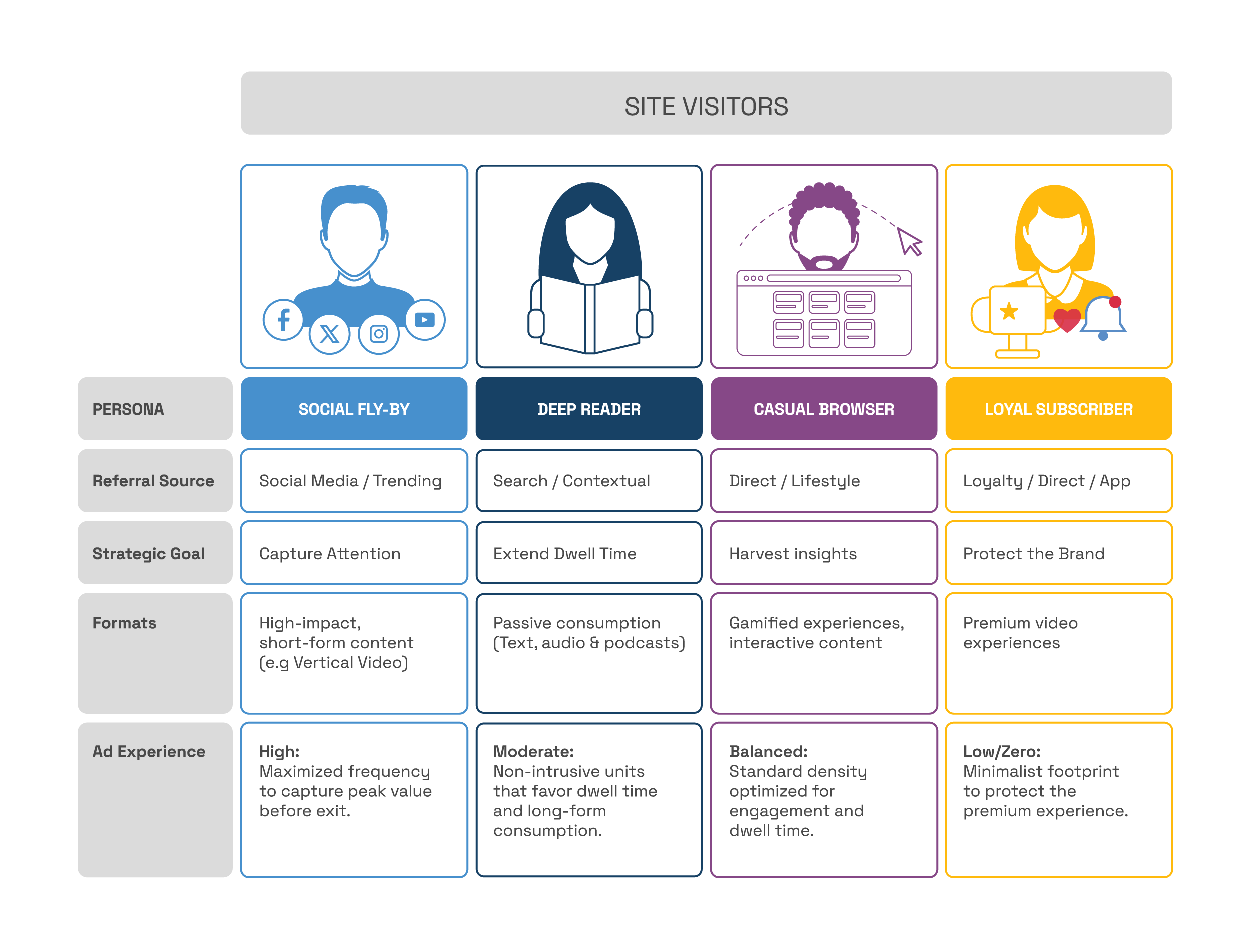
The Engage pillar replaces the one-size-fits-all approach with something publishers have never actually had before: the ability to configure the content experience based on who just showed up and what they are likely to want. Advertisers have spent the last 20 years building platforms that tailor ad experiences to consumers through dynamic creative optimization. Publishers have never had access to an equivalent capability. Now they do.
When a social fly-by arrives from Facebook, someone who encountered a short-form clip in their feed and clicked through, the orchestration platform detects that signal and automatically activates a vertical video experience tailored to their interests. The system recognizes who just showed up, infers what they are likely to want, and configures the experience accordingly.
And the elements that can be personalized go well beyond content recommendations. The rules engine governing the Engage pillar allows publishers to control multiple elements of the page simultaneously, based on predefined audience segments. Page layout, content presentation format, voice narration style, advertising placements: all of them configured in concert rather than managed in isolation using experience strategy rules.
This is a meaningful departure from how publisher technology has historically worked. The traditional approach optimizes individual elements independently: an ad server optimizes ad placements, a recommendation engine optimizes content suggestions, a CMS manages layout. Each operates in its own silo, with its own logic, against its own objectives. Nobody is talking to anybody else.
The orchestration layer replaces that fragmented approach with a unified view of the visitor experience. Rather than optimizing individual ad units or isolated pieces of content, publishers can optimize the entire visit at once. The result is a more coherent, more relevant, and more valuable interaction for both the audience and the publisher.
From Pageviews to Engagement Equity
This shift requires a new way of measuring success. The traffic-driven model had a straightforward metric: pageviews. More traffic meant more ad impressions meant more revenue. That logic held as long as traffic was the primary input into publisher economics.
As we have documented throughout this series, traffic is no longer a reliable proxy for publisher value. Pageviews from anonymous social visitors who bounce after ten seconds generate very different economic outcomes than deep engagement from loyal readers who return repeatedly, consume multiple content formats, and represent real subscription conversion potential. The math is just not the same.
The Engage pillar introduces a new measure of publisher success: Engagement Equity. Engagement Equity reflects the depth and persistence of audience interaction - how long people stay with content, how frequently they return, and how meaningfully they engage with a publisher's brand across platforms.
Rather than counting raw pageviews, publishers begin measuring the depth, quality, and persistence of audience relationships over time. In the attention economy, the most valuable publishers will not be those who attract the largest number of clicks. They will be the organizations that can sustain attention across multiple formats, channels, and environments and convert that sustained attention into durable revenue.
Why This Matters for What Comes Next
Engagement Equity is not just a better metric. It is the foundation for everything that follows in the orchestration loop. As audience relationships strengthen, as the system learns who your most valuable visitors are and how to deepen their connection to your brand, the final stage of the loop becomes significantly more powerful.
Converting that accumulated attention into revenue is the job of the Monetize pillar. And as we will see next week, the publishers who have done the Engage work well will find the monetization math looks very different from those who have not.
Next week, we go inside the Monetize pillar.
This is Week 8 of The Great Decoupling, our publisher thought leadership series. Read the full white paper at jwx.com.
By John Nardone, CEO at JWX