

Last week, we introduced the Orchestration Layer and its four pillars: Transform, Distribute, Engage, Monetize. We called it an operating system for storytelling. This week, we go inside the first pillar - because this is where the new economics of publishing actually begins.
It starts in the newsroom. And it starts with a problem every editor I've ever talked to recognizes immediately.
The Invisible Story
For most of publishing history, a story had a pretty straightforward lifecycle. Reporter files it. Editor shapes it. CMS publishes it. Social team promotes it. That workflow was built for a world where text was the dominant format and search was the primary discovery engine.
That world is gone.
In the algorithmic feed economy, content that only exists as text is effectively invisible to the platforms where audiences now spend their time. TikTok, Instagram, YouTube - these environments are built around video, audio, and interactive formats. A well-reported article that never becomes a video, never gets turned into an audio narration, never shows up as a short-form clip. Large and growing segments of your audience will simply never see it. Not because it isn't good. Because it doesn't fit the format.
This is what we call Algorithmic Inertia: the risk that high-quality journalism fails to find its audience not because of a content problem, but because of an infrastructure problem. The story is there. The audience is there. The pipeline between them isn't.
The data makes this impossible to ignore. 79% of media executives say investing more in video is a priority in 2026. 71% are expanding into audio, both a direct response to AI's impact on text-based content. [1] The direction of travel is unambiguous. The question is whether publishers can actually get there without breaking their newsrooms in the process.
.png?width=2500&height=1308&name=Create%20Once%2c%20Adapt%20Everywhere_blog_stats_vertical%20(1).png)
What the Transform Pillar Actually Does
The transformation layer is the answer to that question. It lets publishers turn a single editorial asset into multiple formats, without adding headcount or blowing up the workflow they already have.
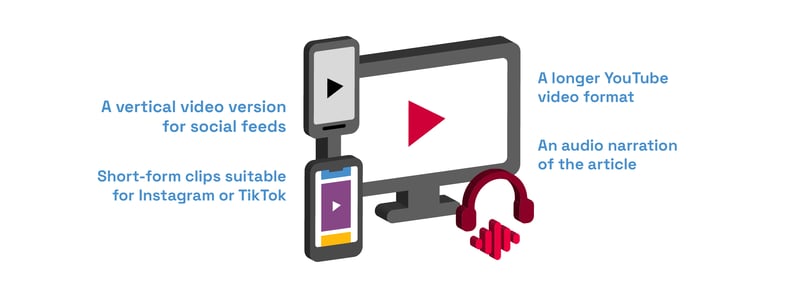
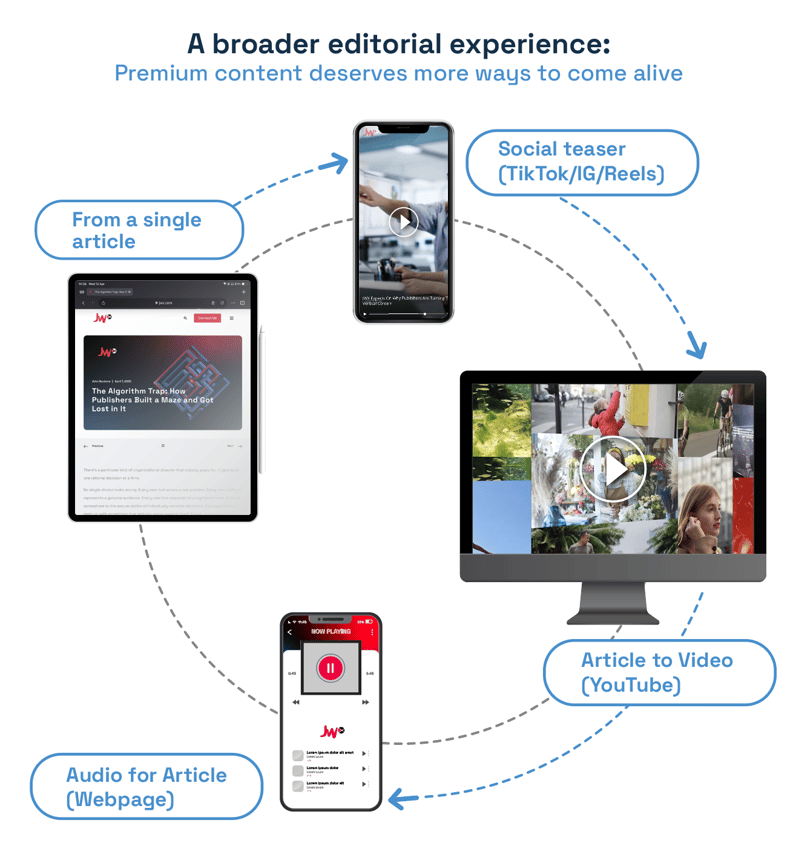
Here's how it works in practice. An article is performing well with a specific audience segment, say, women 25 to 34 who are interested in personal finance. The system sees that, and surfaces transformation opportunities built from the original story: a vertical video optimized for social feeds, short-form clips for Instagram or TikTok, a longer YouTube format, an audio narration of the piece. All of it generated with AI assistance from content that already exists. And critically, the editor stays in control, reviewing, editing, approving every transformation before anything goes live. The process takes minutes, not days.
What you end up with is a portfolio of content expressions from a single piece of journalism, each one optimized for the environment where it's going to land. The newsroom doesn't have to produce more. It has to unlock what's already there.
That's the principle at the heart of the Transform pillar: Create Once, Adapt Everywhere.
Why This Changes the Economics
Traditional publishing has always had a fundamental inefficiency built into it. A story requires real investment to produce, reporting, writing, editing, fact-checking. And then it generates revenue through a pretty narrow set of opportunities, mostly display advertising against a single webpage. The costs are front-loaded. The yield is constrained.
The transformation layer changes that ratio. A single story, expressed across multiple formats, becomes the foundation for a much larger set of distribution opportunities, audience interactions, and revenue events. The editorial investment stays roughly the same. The potential yield expands significantly.
Think about it this way. Publishers have spent years building something genuinely valuable: original, trusted journalism that audiences seek out. But they've been leaving a huge portion of that investment's value on the table, because they couldn't get it into the formats audiences now demand. That's not a content problem. It's a tools problem. And that's exactly what the Transform pillar is built to solve.
The Limits of the Old Workflow
I want to be direct about what gets in the way here, because it's worth naming.
Most publisher workflows were designed to move stories from reporter to webpage as efficiently as possible. That system is good at what it was built for. What it was not built for is the multi-format, multi-platform reality publishers are actually operating in today. When you try to bolt video production, audio narration, and social clip creation onto a workflow that was engineered for text articles, you get exactly the kind of operational friction that makes format expansion feel like a burden instead of an opportunity.
That's what the transformation layer removes. Format expansion stops being a separate production effort running in parallel and becomes a natural extension of the editorial process that already exists.
Why We Acquired Aug X Labs
This is why we acquired Aug X Labs, the company behind Augie Studio, in January 2026. Augie Studio (now JWX Studio) adds an LLM-powered content transformation layer to the platform. The result is a system that makes the Create Once, Adapt Everywhere principle operational. As we continue to advance the technology, the goal is to enable editorial teams to transform a single story into multi formats, including short-form and long-form video, audio, games, polls, and other interactive formats in minutes, with full creative control at every step.
This acquisition is part of JWX's broader mission to help publishers extend content value, improve operational efficiency, and unlock monetization opportunities at scale. The Transform pillar now has the infrastructure to back it up.
What Comes Next
Transforming a story into multiple formats is only the beginning. Once those assets exist, the next challenge is getting them to the right audiences, across the right platforms, at the right moment. That's the job of the Distribute pillar, and it's where the data feedback loop that makes the whole system intelligent starts to take shape.
Next week, we go inside Pillar 2: Distribution.
This is Week 6 of The Great Decoupling, our publisher thought leadership series.
Read the full white paper at jwx.com.
Sources:
[1] Reuters Institute: Journalism, Media and Technology Trends and Predictions 2026 | https://reutersinstitute.politics.ox.ac.uk/sites/default/files/2026-01/Trends_and_Predictions_2026.pdf