

The New Architecture of Authority: What We Built, and What Comes Next
Twelve weeks ago, we opened this series with a simple claim: the rules of digital publishing had changed, and most publishers had not yet changed with them.
We called it the Great Decoupling. The breaking of a fifteen-year arrangement between publishers, platforms, and search engines that had quietly governed the economics of digital media. Search referrals declining. Social platforms evolving from traffic drivers into closed attention ecosystems. AI interfaces absorbing the queries that once sent readers to publisher pages. Each force compounding the others. The destination web, the model that publishing had been built around, was losing viability faster than most leadership teams were willing to say out loud.
That was the diagnosis. This week is about the response.
What We Have Covered
The problem was never the journalism. Publishers who have spent years building trusted, credible, editorially rigorous content possess something that platforms have spent a decade trying and failing to replicate. The authority a publisher has earned through consistent, professional storytelling, the integrity, the editorial standards, the emotional connection with a loyal audience, is not replicable by an algorithm or a social feed. It is the single most durable competitive asset in modern media, and it belongs entirely to the publisher.
The problem was the plumbing.
Legacy technology stacks, the Franken-Stacks assembled over years of bolt-on solutions, were built for a destination web that no longer exists. They optimized for website publishing in a world where audiences now discover content in feeds, social platforms, and video environments. They measured success in pageviews at a time when pageviews are becoming an increasingly unreliable proxy for publisher value.
The answer we have been building toward across this series is an Orchestration Layer: infrastructure that connects the full lifecycle of a story from creation to revenue, across every environment where audiences now spend their time.
The Four Pillars, Briefly Restated
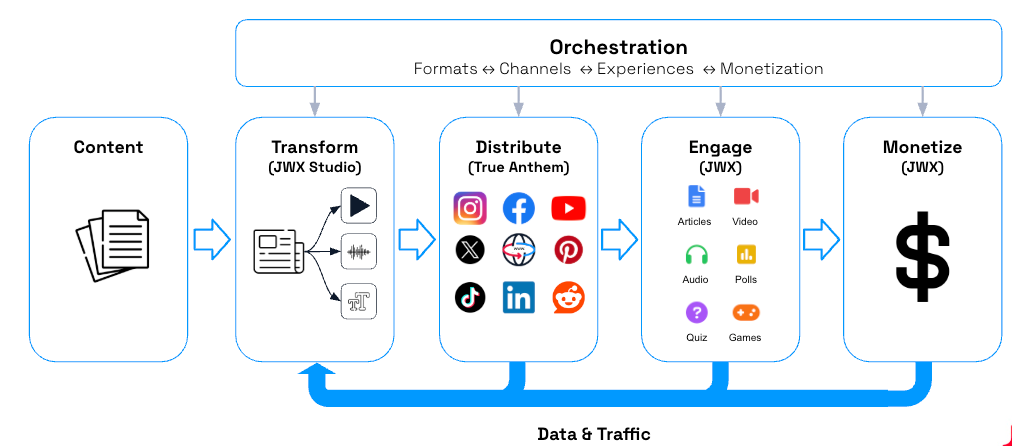
The Transform pillar converts a single piece of journalism into every format modern audiences expect: vertical video, short-form clips, audio narration, long-form YouTube content, and more, without requiring additional editorial staff. The principle is Create Once, Adapt Everywhere. The acquisition of Aug X Labs, now JWX Studio, is the infrastructure that makes it operational.
The Distribute pillar routes those transformed assets intelligently across a fragmented platform landscape, matching the right content expression to the right environment at the right moment. A predictive virality score guides editorial energy toward the content most likely to perform. A unified data loop tracks revenue attribution across every surface. True Anthem is the infrastructure that makes it operational.
The Engage pillar replaces the one-size-fits-all visitor experience with personalized experiences built around audience identity and behavioral signals. Publishers have never had access to the kind of dynamic experience optimization that advertisers have used for years. The Engage pillar changes that, introducing Engagement Equity as the new measure of publisher success: the depth, quality, and persistence of audience relationships over time.
The Monetize pillar captures revenue across three complementary pathways simultaneously: owned properties, distributed platforms, and branded content. It is governed by the strategic distinction between Yield Machine and Brand Sanctuary. The publisher who understands the full revenue footprint of every story they publish will always outinvest, outproduce, and outlast the one who does not.
Together, these four capabilities transform the publisher from a static website into an Adaptive Content Engine: a system designed to maximize the value of trusted content wherever audiences exist.
The Shift That Matters
In the traffic era, success was defined by pageviews. In the attention economy, success will be defined by yield per story.
That is not a philosophical distinction. It is an economic one. Publishers still operating on a traffic model are leaving an increasing share of their potential revenue on the table with every story they publish. The gap between publishers who have built orchestration infrastructure and those who have not is not closing. It is widening. And unlike the Referral Cliff, which arrived as an external force, this is a gap that publishers are actively choosing to close or not.
The Great Decoupling is not an apocalypse for publishing. It is a filter. The organizations that emerge stronger will be the ones that stopped waiting for the platforms to become more generous, or for the algorithms to stabilize, or for the market to settle. And started building instead.
The Future Belongs to Builders
Reinvention is now the central job of premium media. New formats create new experiences. New experiences create new revenue paths. And trusted, professional storytelling remains the foundation that everything else is built on.
The next era of publishing will not be defined by platforms. It will be defined by the builders who refused to cede their audiences, their economics, and their editorial authority to systems designed to serve someone else's interests.
That work is underway. And so is ours.
We are building this adaptive content engine because we believe premium publishers deserve infrastructure that matches their ambition. Infrastructure that transforms trusted journalism into every format modern audiences expect. That distributes it at platform speed. That deepens audience relationships over time. That monetizes attention wherever it lives.
We are just getting started. So are you. That is exactly the point.
If you are ready to build the next chapter of your business, we would like to build it with you.
This has been The Great Decoupling, our publisher thought leadership series. Read the full white paper at jwx.com.